The 2025 Electoral Map Redrawn: Five Conservative Ridings Where Progressive Momentum Is Building
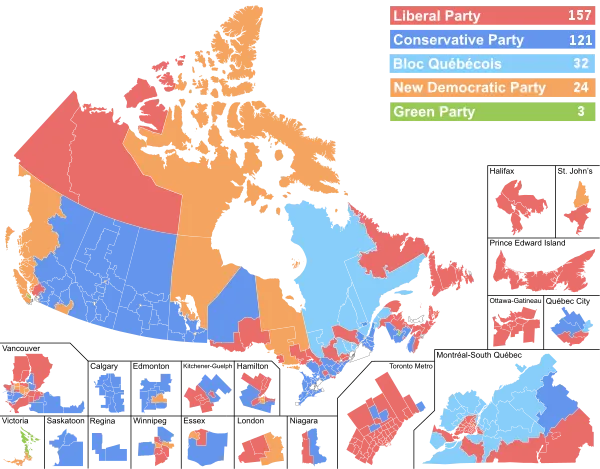
Photo: Titanciwiki, CC BY-SA 4.0, via Wikimedia Commons
Canada's electoral map has long been described in terms of entrenched colour — vast swaths of blue dominating suburban and rural landscapes, with islands of red and orange clustered in urban cores. Yet elections are not monuments; they are living measurements of a society in motion. Demographic change, economic anxiety, and a generational transfer of political identity are quietly redrawing boundaries that once seemed permanent.
At Red to Blue CA, our mandate is straightforward: identify where progressive energy can be converted into electoral results. Using Elections Canada data, Statistics Canada census projections, and regional polling aggregates, we have identified five Conservative-held ridings that represent the most credible opportunities for a progressive breakthrough in the next federal election.
Why These Ridings, Why Now
The methodology behind this analysis rests on three pillars: margin of victory in the last two federal elections, demographic velocity (the rate at which a riding's population profile is shifting), and local political signals such as municipal election results and community organizing activity.
A riding that a Conservative MP won by eight points in 2021 but where the urban fringe is expanding, post-secondary enrolment is rising, and a new community health centre just became a flashpoint issue is a very different riding than one that voted Conservative by the same margin with a static population. Context transforms data into strategy.
1. Fleetwood–Port Kells, British Columbia
Located in Surrey's northeastern corridor, Fleetwood–Port Kells has undergone one of the most rapid demographic transformations of any suburban riding in Western Canada. South Asian Canadian families — many of them second-generation professionals with post-secondary credentials and strong civic participation rates — now constitute a plurality of the electorate. The Conservative margin here narrowed from over twelve points in 2019 to fewer than five in 2021.
Critically, municipal politics in Surrey have grown increasingly contentious around policing, transit investment, and housing affordability — issues on which progressive federal candidates hold structural advantages. A well-resourced campaign with culturally competent outreach and a credible local candidate could close that gap entirely.
2. Kitchener–Conestoga, Ontario
The Waterloo Region has long been a tale of two political cities: the urban core trending progressive while the rural and exurban periphery anchors Conservative incumbents. Kitchener–Conestoga sits at that fault line, and the fault is shifting.
The expansion of the University of Waterloo's research corridor into the riding's southern reaches is bringing younger residents, tech-sector workers, and internationally educated professionals into communities that once voted Conservative by default. The 2021 result — a Conservative hold by roughly 6,500 votes — looks considerably more fragile when one accounts for new subdivisions, a growing rental market, and intensifying concern about federal climate policy among the riding's agricultural communities, who are increasingly exposed to the economic costs of extreme weather events.
3. Banff–Airdrie, Alberta
Including an Alberta riding on a list of progressive opportunities will raise eyebrows, and that scepticism is not without basis. However, Banff–Airdrie is not a monolithic conservative constituency. The Banff townsite and the Bow Valley corridor are home to a young, environmentally engaged workforce employed in tourism and hospitality — industries directly imperilled by climate inaction. This community has returned progressive municipal councillors and has demonstrated a consistent appetite for candidates who take ecological stewardship seriously.
The strategic opening here is not a full flip but a targeted vote-efficiency play: consolidating the progressive vote behind a single candidate through coordinated engagement with the NDP and Green voting blocs could dramatically reduce the Conservative majority and lay groundwork for a genuine contest in a subsequent election.
4. Miramichi–Grand Lake, New Brunswick
Atlantic Canada's political volatility is chronically underestimated by national strategists. Miramichi–Grand Lake, anchored by a working-class forestry and fisheries economy, has experienced significant economic disruption over the past decade. Plant closures, fishery quota disputes, and insufficient federal infrastructure investment have created a constituency that is genuinely persuadable — not ideologically progressive, but pragmatically open to candidates who demonstrate a credible economic plan.
The 2021 margin here was under 3,000 votes. A candidate who can speak authentically to resource-sector workers about just transition supports, rural broadband access, and health care wait times — without condescension — has a genuine path to victory. This is a riding where progressive values must be expressed through economic language, not cultural signalling.
5. Cloverdale–Langley, British Columbia
Cloverdale–Langley is perhaps the most data-compelling entry on this list. Population growth in the Cloverdale and Clayton neighbourhoods has been extraordinary — among the fastest in Metro Vancouver's suburban ring. New residents skew younger, are more likely to be renters, and are acutely sensitive to housing costs, transit access, and child care availability: precisely the policy terrain on which progressive federal platforms have the strongest contrast with Conservative alternatives.
The Conservative incumbent won in 2021 by approximately 7,200 votes, but that victory was built on a voter base that is being numerically diluted by incoming residents who have no established partisan loyalty to the incumbent. Voter registration drives and first-contact canvassing in newly built neighbourhoods represent the single highest-return investment a progressive campaign could make in this riding.
Turning Intelligence Into Action
Data without organisation is merely interesting. What transforms these five ridings from theoretical opportunities into actual wins is the presence of activated local campaigns — riding associations that are recruiting volunteers today, identifying candidate talent, and building the relational infrastructure that no amount of national advertising can replicate.
If you live in or near any of these ridings, the most consequential thing you can do right now is connect with your local Liberal, NDP, or Green riding association. Attend a meeting. Knock on a door. Host a conversation in your community. The electoral map is redrawn one conversation at a time, and the conversations happening in 2024 will determine what the map looks like on election night 2025.
The blue on Canada's electoral map is not immovable. It is, in many places, simply waiting for the right campaign to arrive.