One Knock, One Hundred Doors: How a Single Volunteer's Commitment Is Rewriting the Electoral Math in Ridings Across Canada

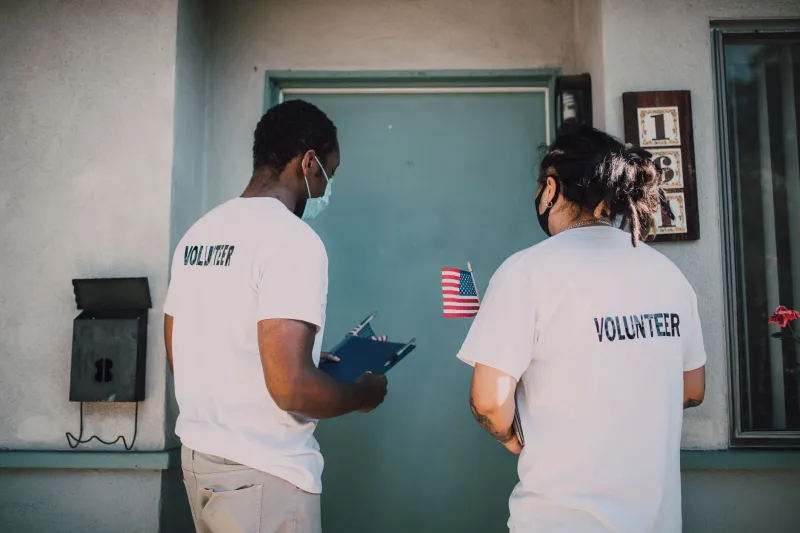
There is a particular kind of political momentum that no polling firm captures and no party war room can manufacture on demand. It does not originate in a campaign headquarters or a national advertising buy. It begins, almost always, with one person standing at the end of their driveway, clipboard in hand, deciding that this time they will do more than vote.
Across Canada, progressive campaigns have been quietly documenting what veteran organizers call the volunteer multiplier effect — the phenomenon by which a single committed individual, through peer recruitment, social trust, and the simple act of modelling civic engagement, generates a cascade of involvement that reshapes the volunteer base of an entire riding campaign. Understanding this effect, and learning to cultivate it deliberately, may be one of the most consequential strategic assets available to progressive movements operating outside the financial reach of well-funded Conservative incumbents.
The Arithmetic of Persuasion Among Peers
Conventional campaign mathematics tends to focus on voters: how many doors can be knocked, how many calls placed, how many persuadable residents reached before election day. What this framing underestimates is the parallel arithmetic of volunteer recruitment — specifically, the compounding returns that follow when one engaged citizen draws in two more, each of whom draws in two more still.
Research from community organizing traditions in both Canada and comparable democracies consistently finds that the most effective volunteer recruiters are not campaign staff. They are neighbours, coworkers, and friends — people whose social credibility within a given community far exceeds that of any party representative arriving from outside. When a longtime resident of Brantford or Lethbridge or Nanaimo tells someone they respect that they have been out canvassing on Saturday mornings, the implicit message is not merely informational. It is a signal about identity, belonging, and what engaged citizenship looks like in that specific community.
This is the mechanism at the heart of the multiplier effect: not persuasion in the abstract, but social contagion through trusted networks.
A Case in Point: The Quiet Cascade
Consider the pattern that emerged in a competitive Ontario riding during a recent federal campaign cycle. A retired schoolteacher — politically engaged but never previously a campaign volunteer — attended a single progressive candidate's community meeting in the autumn before an election. She left with a commitment to knock doors in her subdivision one Saturday morning.
Within three weeks, she had recruited seven neighbours, including two who described themselves as lifelong Conservative voters now uncertain about the party's direction. Those seven collectively brought in eleven more volunteers before the writ dropped. By the final weeks of the campaign, the riding's volunteer corps had grown by more than forty percent in her polling district alone — a district that had previously been considered a low-yield area for canvassing resources.
The candidate did not win that seat. But the margin closed substantially, the riding was formally reclassified as competitive for the following cycle, and the volunteer network the schoolteacher helped build remained intact, continuing to meet monthly well after election day.
This is not an isolated story. Organizers from British Columbia's Fraser Valley to Nova Scotia's South Shore report strikingly similar dynamics: a single individual with deep community roots, given the right entry point and modest logistical support, becomes a hub from which volunteer engagement radiates outward in ways that top-down recruitment drives rarely replicate.
Why Peer Recruitment Outperforms Institutional Outreach
Progressive campaigns operating in Conservative-held ridings frequently face a credibility gap. The party brand, the candidate, even the policy platform may carry associations that make initial contact difficult. A flyer through the mail slot is easy to dismiss. A phone call from a campaign office generates reflexive suspicion. But a conversation with someone who lives two streets over, whose children attend the same school, who has no visible stake in professional politics — that is a different kind of contact entirely.
Psychological research on social influence consistently identifies perceived similarity and relational trust as the two most powerful predictors of attitude change. Peer volunteers embody both. They are not asking a stranger to trust an institution; they are asking a neighbour to trust them. In communities where institutional trust has eroded — and in many Conservative-leaning ridings across Canada, that erosion runs deep — this distinction is not incidental. It is the entire ballgame.
For progressive campaigns specifically, this dynamic offers a structural advantage that money cannot straightforwardly replicate. A well-resourced Conservative incumbent can blanket a riding with mail, digital advertising, and professional canvassers. They cannot manufacture the social authority of a trusted community member who has chosen, of their own accord, to spend their weekends advocating for change.
Engineering the Cascade: What Campaigns Can Do
The multiplier effect is not entirely spontaneous. While it depends on organic social dynamics, campaigns that understand its mechanics can create conditions that make it far more likely to emerge.
First, lower the barrier to the first commitment. Many potential volunteer multipliers never begin because they imagine campaign involvement requires a level of political sophistication or time investment they cannot offer. Campaigns that frame the initial ask as modest — one Saturday morning, one conversation with one neighbour — find that people who would have declined a larger commitment become entry points into deep engagement.
Second, give early volunteers visible social legitimacy. Public recognition, even in small forms — a mention at a community meeting, a photograph on a local campaign social media page — signals to the broader community that this is something real people are doing. Visibility begets imitation.
Third, build infrastructure for volunteer-to-volunteer recruitment rather than relying exclusively on staff-to-volunteer pipelines. This means training early volunteers to make the peer ask themselves, providing them with simple language to use, and tracking referral chains so that the multiplier effect becomes legible to campaign leadership rather than invisible.
Finally, treat the post-election period as seriously as the campaign itself. The networks that generate multiplier effects do not expire when the ballots are counted. Campaigns that maintain those connections — through community events, ongoing issue advocacy, or simple social gatherings — preserve the social capital that makes the next electoral cycle begin from a far stronger position.
The Riding That Changes Because of One Person
There is something quietly extraordinary about the idea that a single individual's decision to volunteer can, through the logic of social networks and peer trust, alter the political trajectory of an entire community. It runs counter to the prevailing narrative of electoral politics as a game played by parties, donors, and professional strategists.
But the evidence from campaigns across Canada suggests that this is precisely what happens — not occasionally, and not only in unusual circumstances, but as a predictable consequence of how human communities actually function. People follow people they trust. Engagement is contagious. And in a riding that has been written off as safely Conservative for a generation, the cascade that begins with one person knocking on one door may be the most consequential force in play.
For progressive organizers, the strategic implication is clear: find that person, give them a reason to begin, and then get out of the way.