The Persuadable Voter: What Moves Canadians to Cross the Political Divide
Photo: diverse Canadian suburban community residents conversation neighbourhood, via imgv2-2-f.scribdassets.com
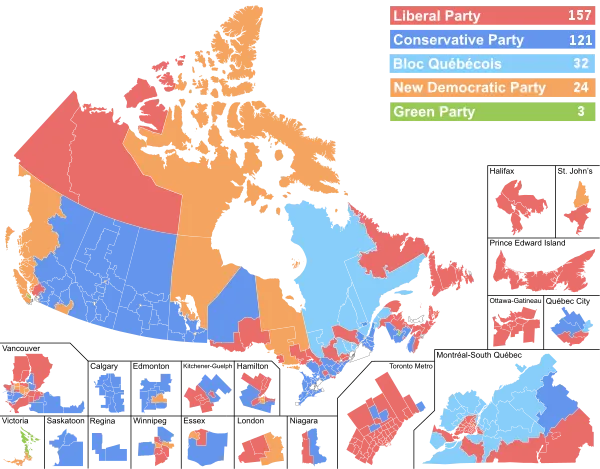
Political strategists spend enormous energy reinforcing the loyalty of committed partisans. But elections are rarely decided by the already-converted. They are decided by the people in the middle — the swing voters whose allegiances are neither fixed nor predictable, and whose choices in a handful of competitive ridings can determine which party forms government.
Red to Blue CA spent several weeks speaking with Canadians in suburban and rural communities who have changed their votes in recent federal elections — some moving from Conservative to progressive parties, others shifting in more complicated directions. What emerged from those conversations is a portrait of the persuadable voter that defies easy caricature, and a set of insights that progressive campaigns would be wise to take seriously.
Who Are These Voters, Really?
The first thing to understand about persuadable voters is that they tend to resist the labels that political operatives use to describe them. The people we spoke with did not think of themselves as swing voters or as members of any political demographic. They thought of themselves as Canadians trying to make reasonable decisions in complicated circumstances.
Take Darren, a fifty-one-year-old electrician from the outskirts of Barrie, Ontario. He voted Conservative in 2015 and 2019, then shifted his vote in 2021. The trigger, he says, was not a single policy announcement or a debate performance. It was a conversation with his adult daughter about the cost of renting in the city where she worked.
"She's got a college diploma, she's working full-time, and she can't afford a one-bedroom apartment," he told us. "I started asking myself what I actually believed about government's responsibility to make sure that kind of thing doesn't happen. And my answers surprised me."
Or consider Marlene, a retired school administrator from a small community outside of Prince George, B.C. She describes herself as a lifelong Conservative voter who began to reconsider during the pandemic. "I watched how different governments responded, and I started paying more attention to what the actual policies were," she said. "I had always assumed that Conservative meant competent and responsible. I'm not sure I believe that anymore."
These are not unusual stories. Across the conversations we had, a consistent pattern emerged: persuadable voters are moved not by grand ideological arguments, but by specific, lived experiences that cause them to re-examine assumptions they had previously taken for granted.
The Issues That Open Doors
Housing affordability came up in virtually every conversation we had — not as an abstract policy debate, but as a deeply personal concern about the futures of children, grandchildren, and neighbours. In communities that have historically leaned Conservative, there is a growing recognition that market forces alone have not produced the outcomes that were promised, and that some form of more active government intervention may be necessary.
Health care access was another consistent theme, particularly among voters in rural and semi-rural ridings where clinic closures and doctor shortages have become tangible daily realities. Several voters we spoke with described a specific moment — a long wait for a specialist, a family member unable to access timely mental health support — that shifted their sense of which party's approach to public services they trusted more.
Perhaps most surprisingly, a number of voters raised concerns about democratic integrity and political honesty. This was not framed in partisan terms. These voters were not necessarily fans of any particular party. But they expressed a deep frustration with what they perceived as cynical or dishonest political communication, and a corresponding openness to candidates who spoke plainly and acknowledged complexity.
What Doesn't Work — And Why
The voters we spoke with were notably resistant to certain types of progressive messaging that campaigns sometimes rely upon.
Moralising language consistently landed poorly. Several voters described feeling lectured to by progressive campaigns — as though the implicit message was that their previous voting choices reflected a character flaw rather than a reasonable, if different, set of priorities. "I'm not a bad person because I voted Conservative," said one participant from the Okanagan. "If you want my vote, talk to me like I'm a reasonable adult."
Abstract appeals to solidarity or systemic analysis also tended to fall flat with this cohort. Voters who were open to shifting their support wanted to understand, in practical and specific terms, how a policy change would affect their lives or the lives of people they knew. Broad framing about inequality or structural injustice, without grounding in concrete local impact, was frequently described as "political speak" — a category these voters applied to any messaging that felt rehearsed or insincere.
Negative campaigning produced mixed results. While some voters said that learning about a candidate's record changed their assessment, others described aggressive attack advertising as a reason to disengage from politics altogether — a dynamic that tends to suppress turnout rather than redirect it.
What Progressive Campaigns Can Learn
The lessons from these conversations are not about abandoning progressive values. They are about communicating those values in language that connects with voters who do not yet share the same political vocabulary.
Several principles emerge consistently:
Lead with shared values, not party identity. Voters who shifted their support often described a moment of recognising that a candidate or party shared something they cared about — not a party platform, but a value. Fairness. Responsibility. Looking out for your neighbours. Progressive campaigns that lead with these shared touchstones, rather than with partisan branding, tend to find more purchase.
Acknowledge what has been lost. Many persuadable voters in traditionally Conservative communities have a genuine attachment to values that they associate with their previous party — fiscal responsibility, individual agency, community self-reliance. Progressive campaigns that dismiss or ignore these values lose credibility. Those that engage with them honestly, and make the case that progressive policy is actually more consistent with those values than the alternative, tend to be more effective.
Invest in trusted local voices. The conversations that move persuadable voters are almost never initiated by party operatives or campaign literature. They happen between neighbours, family members, and colleagues. Progressive campaigns that identify and support trusted community voices — local business owners, coaches, faith leaders, healthcare workers — create far more persuasive conditions than any centralised messaging strategy can achieve.
Be patient and present between elections. Several voters told us that their political shift began not during a campaign, but during a quieter period when a local candidate or organiser had simply been present in the community — attending events, listening, being visible without an obvious electoral agenda. That kind of sustained, authentic presence builds the trust that makes persuasion possible when it matters most.
The voters in the middle are not a mystery to be solved. They are Canadians navigating real lives, weighing real trade-offs, and making reasonable decisions with the information and experiences they have. Progressive campaigns that approach them with genuine respect — and with the patience to build relationships rather than simply chase votes — will find that the political map is more moveable than it might appear.